Last week I experimented in how I display and mount two works; both are collages working with and from dry lasagne sheets (some painted, some not) and other materials. In what follows I write about one of these collages and some connections that arose with Carl Jung’s remarks in his 1949 Preface to the I Ching.
Mermanmade is a 12 cm x 12 cm sculpture which was produced through playing with lasagne shards, paper, and cloth (formerly used to clean brushes). I made it as part of an invitation to contribute work to a group exhibition – since cancelled – that had pasta as part of its theme. After making four works from shards of lasagne sheets, I appeared to turn towards recognising forms in the assemblages and stopping when I saw something.
Through the activity of making and playing, I saw the form became a human figure, then a human character: upright, the human has a long, elongated, teardrop, fish or almond-like head shape, atop a body, whose right arm in blue extends vertically, and whose left arm is seen held up. Is it pointing? Is it giving? Is it receiving? The weight and heaviness, the burden of the material which roots the human figure seemed to me like the tail of a mermaid, but I quickly concluded there was no reason for this figure to not be a merman/merlad. Hence the title’s composite pun, which refers to the product of making too.
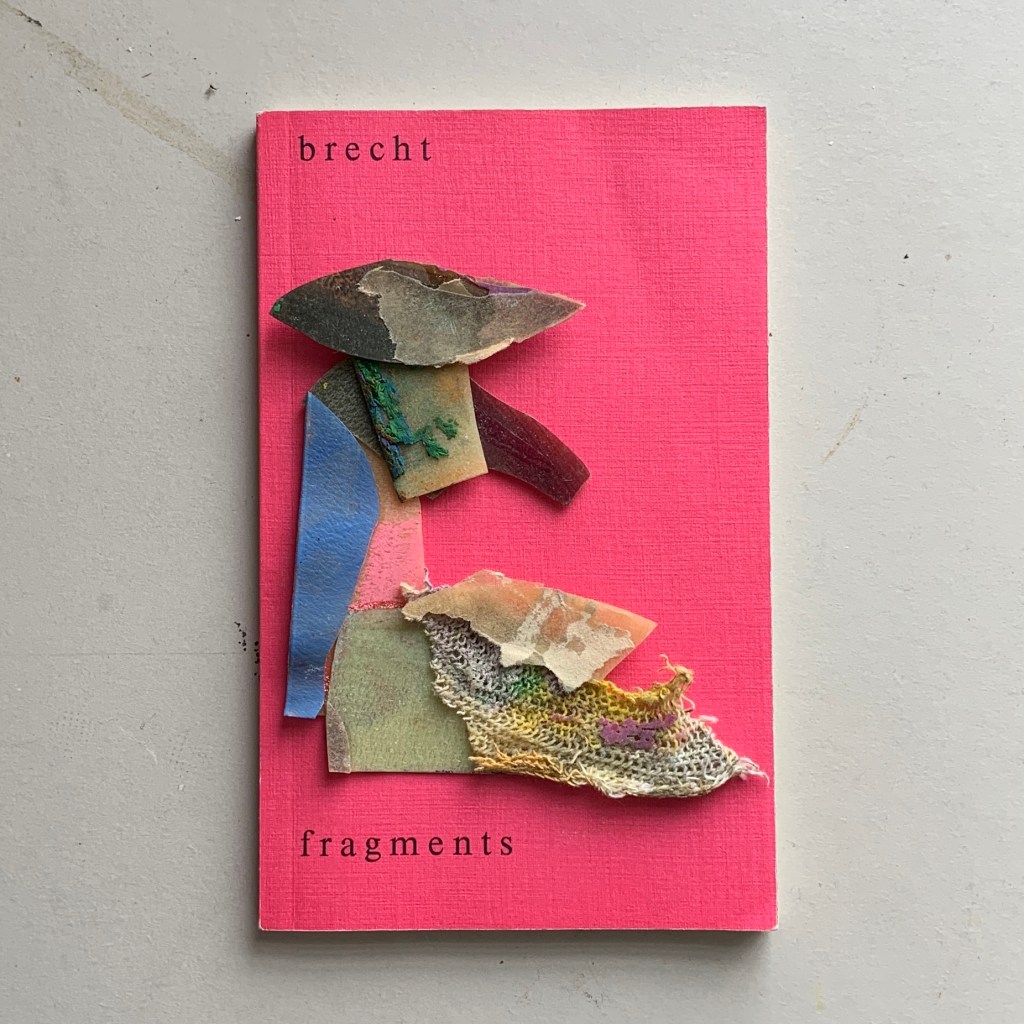
Mermanmade. 2024. 12 x 12 cm. Cloth, lasagne sheets, oil paint, paper, pastel and superglue, laid on brecht : fragments (2024), Raven Row, London: UK.
I laid the work on top of brecht: fragments (2024), a free, small collection of printed texts with images published by Raven Row (London, UK) in conjunction with the exhibition of the same name. One might consider the collection of texts to both respond to the exhibition as well as aid in its curation. It also extends the viewer’s engagement with the exhibition beyond physical attendance at the show, through reproduction of select images and collation of written texts that explore and interpret Bertolt Brecht’s relationship with collage.
I love the pink hue of the book. It is at once soft and urgent, faintly textured to touch. Pocket-size, the book is highly amenable to a travelling reader.
I love the combination of the work on top of this hue, but, thinking through what to make of the placement, I made a connection between the collage and playful assembly of Mermanmade, which, prior to its coming-into-being, I had no premonition or idea I would make – and the process of collage that Brecht used in order to create plots. Pieces can be moved about to generate ideas, forms, relationships.
Seeing forms and figures in abstract compositions is nothing new and is widely reported, in clouds, walls, graphic marks, and the like. The relationship of the artist in making this figure, in ending up there, and in recognising and developing a character by naming – as I did in the first paragraph – remind me of Carl Jung’s preface to the I Ching:
“In the I Ching, the only criterion of the validity of synchronicity is the observer’s opinion that the text of the hexagram amounts to a true rendering of his psychic condition. It is assumed that the fall of the coins or the result of the division of the bundle of yarrow stalks is what it necessarily must be in a given “situation,” inasmuch as anything happening in that moment belongs to it as an indispensable part of the picture.” (Jung, 2013).
It is interesting that Jung uses a pictoral metaphor. I think of this part of his preface because, in the same way that I looked at the forms of lasagne shards that I pieced together and came to see – build – or be visited by, this mermaid, washerwoman, standing figure (all versions that have arisen in my relationship with this figure), one might ask whether they, and not the yarrow stalks of the I Ching divination, ‘form[ed] the pattern characteristic of that moment’ – that the interdependence of these events (forms, materials, colours, play, situation, moment in time…) conspired – whether through ‘spiritual agencies’ as ‘according to the old tradition’ or something else – to make such ‘picture’ in my mind’ (Jung, 2013).
My question, then: in the work of art made such way – which, being more specific, is the process of making a piece of art and finding a figure along the way – in such a process, is ‘it […] assumed that [it] is what it necessarily must be in a given “situation”‘ (Jung, 2013)?
Jung goes on to say that: ‘such an obvious truth as this reveals its meaningful nature only if it is possible to read the pattern and to verify its interpretation, partly by the observer’s knowledge of the subjective and objective situation, partly by the character of subsequent events’ (Jung, 2013). Is it possible to ‘read the pattern’ in an art work one has made and how would one ‘verify its interpretation’? To do so is done via ‘the observer’s knowledge of the subjective and objective situation’ – the observer, in this case is the artist; the subjective situation may be ascertained, expressed, sounded out, via speech, writing, thought, reflection, conversation…, the objective situation perhaps harder to clarify here. It is also done via the ‘character of subsequent events’, in this case, the figure comes to be divinatory, prophetic, perhaps; its meaning gathered and garnered in retrospect, revealed through the subsequent passage of time.
I’m fascinated in this sense that meaning might unfold over time and that, in the same way Jung talks about how to interpret the divinatory remarks of the I Ching based on the pattern of the yarrow stalks, a maker of something may with time come to see ‘the meaningful nature’ of such a thing (Jung, 2013). I don’t know enough about the I Ching to carry on this line of questioning, but I am interested to explore more the possible analogy between the artist’s (self-)recognition in the act of explorative, improvisational making and the attitude of the observer when ‘casting the yarrow stalks’ (Jung, 2013).
References:
Jung, C.G. (2013). Forward to the I Ching. [online] Jungpage.org. Available at: https://jungpage.org/learn/articles/analytical-psychology/519-forward-to-the-i-ching?showall=1 [Accessed 30 Sep. 2024].
 Laurence Tidy