For Jasmine Staggers
At Gatwick Airport North Terminal, there is a Lego shop.
Georges Didi-Hubermann references Lego when talking about children, naiveté, playing, and assemblage, in the context of Bertolt Brecht’s collages and the role of imagination. The essay entitled ‘imagination’, taken from The Eye of History: When Images Take Positions by George Didi-Huberman, translated by Shane B. Lillis, is included in the small pink volume that accompanied the exhibition of Brecht’s collages at Raven Row, London, in 2024.
In this essay, Didi-Huberman (2024, 89) defines imagination as ‘an unpredictable and infinite construction, a perpetual revival of movements that are engaged, contradicted, surprised by new branchings’. He goes on to describe how this construction ‘creates relationships with differences; it creates bridges over abysses that it opened itself’ (ibid.). (The language here is reminiscent of Baltasar Gracían’s definition of wit as the surprise ensuing from the juxtaposition of unlikely ideas).
In this context, it was surprising not to see Didi-Hubermann cite Walter Benjamin’s passage with the subheading ‘Construction Site’ in ‘One-Way Street’ (1928, published in Benjamin, 2021, 52). In that passage, Benjamin specifically refers to the imaginative capacity that children have for seeing ‘the face that the world of things turns to them’ in objects of scrap, detritus, discard, and waste (Benjamin, 2021, 52). The image is unusual; it reminds us too – ‘the face’ – of the object of the ‘mimetic faculty’ which Benjamin writes about in 1933 and which is collected in the same volume as Verso’s 2021 publication of One-Way Street; for, to see the face in something is to see a face – to see something else in something which it is not, namely, the phenomenon of pareidolia.
But, to gloss this phrase further, it is not the face of one thing but ‘the face that the world of things to them’: it is everything, anything, that pertains to the world, and, in the action of turning, we are almost lifted, with the word ‘world’ , at least in my mind – to an outer-atmosphere view of Earth, anthropormorphised, as it turns on its axis; another day, another cosmic movement, an interconnectedness between child and macrocosm, via the microcosm of the discarded object. Is it a benevolent face? It feels benevolent – it blesses the child.
In any case, Benjamin goes on to say the adult world subordinates such imaginative play to the imperatives of ‘requisites and instruments’ and this prevents that naiveté, this hidden, secret and cosmic revelatory intimacy that plays out between the child’s mind and the wotsit, the nitbit, the scrap and the rag.
It was surprising, therefore, not to see Didi-Hubermann seize this passage as an instance of a common thread running through Benjamin’s and Brecht’s thought and method, philosophical companions as they were.
But, Lego is not what it was, and, reading Didi-Hubermann’s passage today sits awkwardly side-by-side with what Lego actually is.
Discussing Brecht’s cutting and collage, Didi-Huberman (2024, 90) compares the ”construction game’ character’ (a phrase even more reminiscent of Benjamin’s ‘construction site’ passage!) of ‘the technical or artisanal aspect of this imaginative construction’ to the games that ‘children play today with cubes or the aptly named Lego bricks’.
Why are Lego aptly named? I think Didi-Hubermann must be referring to the fact that ‘lego’ means ‘I put together’ in Latin as well as being a portmanteau of the Danish ‘leg godt’ (‘play well) (Wiktionary, 2025). In other European languages the sense of assembling is present: in the Portuguese figurative meaning of the noun lego (‘things that can be assembled together to form a larger thing’) and in Italian the verb legare means to bind, to unite, to connect and link, or to join together.
To someone who spends most of my time assembling and joining things together, these are the kind of ideas that fire me up. But, my question in this post is: is Lego really an apt comparison to this activity of the imagination? And my answer is: I don’t think so, not really, but maybe in one way, and in a way not specific to Lego.
*
It occurs to me first of all that for me to define Lego as what it ‘actually is’ might be an instance of adult instrumentalisation – of requisition to my own argument – which Benjamin criticises in ‘Construction site’. Who knows what a child – or adult – might see in or do with any Lego pieces, Lego set – or a discarded one at the heap – even if it is designed, drawn from, packaged for the construction of, say, ‘Santa’s Sleigh’?
This, to get it out of the way first, is the way in which Lego might be redeemed: as seeing it as any other item, which, disregarded in its ideological packagings, is treated by the child (or any assembler or player) as just another thing, which could be added to, taken away from, and so on. In this case, it becomes any other thing, and what I am saying is not specific to Lego.
In this text, however, my aim is to describe what I saw in the Lego store at Gatwick Airport and ask some questions about what play is. Based on this, my argument is that contemporary Lego (at least) embodies a sort of adultization of play and toys. The ideological values Lego has come to be tied with are, in my view, completely antithetical to play and to the future of life on this planet. Never mind what any one may get out of it, my visit to the Lego store was certainly an ideological smack over the head.
*
Roland Barthes – he would certainly have a field day in the Lego store, seemingly one of the world’s toy outlets for finance capital and culture. (As I am late posting this, you’ll have to imagine yourself back at Christmas 2024 for the sake of what I am describing).
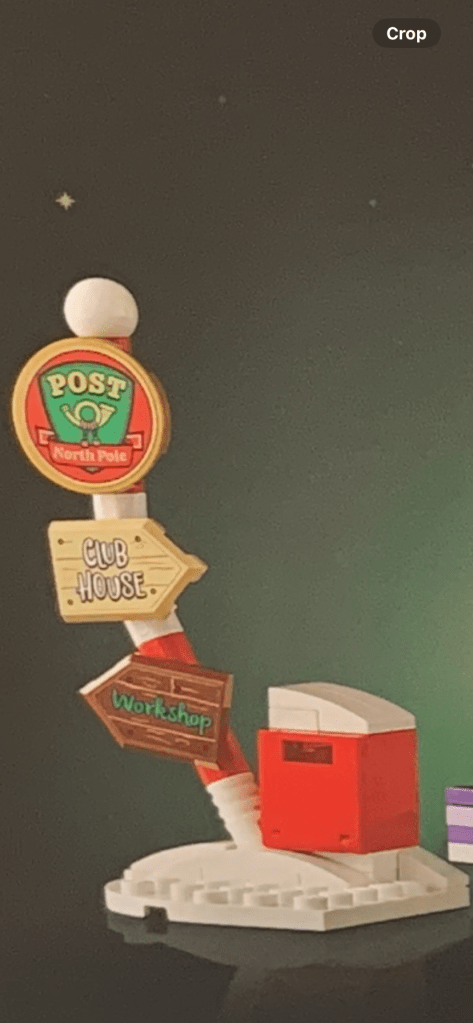
At first, on entry, the Christmas display: ‘Santa’s Sleigh’ is sat next to ‘Santa’s Post Office’. My nearest post office just got shut down. These toys are part of the ‘Winter Village Collection’; given that the large part of people in the UK at least no longer live in villages, you get the idea straight away that part of the cultural strategy underlying these sets is the reconstruction of timeless myths, of idylls which don’t really reflect modern life, and that, with play, comes also a reduced set of safe hierarchies to buttress the imagination – with roles, a boss, and elf employees; the basic template of (maybe even early) capitalist life.
In the village, you read a signpost that says ‘Club House’ on an arrow sign pointing right and ‘Workshop’, on one to the left: so the construction of work time and leisure time even exists at the North Pole. Who knew? Above, in one of a number of transparent plastic domes which encase these ready-made sets, the village is built, with an added ‘Santa’s Delivery Truck’ driven by an elf who wears black glasses – of course.
Petroleum, vehicles, wheels, indeed, all types of cars, rockets, planes, and spaceships fill out the Lego store. The place is fossil-fuelled, and, even, sponsored by and partnered with fossil fuel giants; I had no idea. Land Rover have their Defender, Airbus their Concorde – which, given its ceased existence, furthers the claim of a kind of nostalgic cultural ideology running through their products, this time around technology.
Indeed, the role of partnership, sponsorship, product placement, and promotion abounds: Lego has lended its cuboid, tactile language to all sorts of Hollywood films, film franchises, film studios, TV series, car companies, art galleries (MoMA), as well lining its shelves with its own iterations of series with titles like ‘Creator’, ‘Friends’, and ‘Architecture’ (the latter including Parisian and London skyscapes). If it was possible that the visual and tactile language of Lego could only, really, be suited to the right-angled qualities of, say, buildings and cars, this hasn’t prevented Lego from constructing its ‘Botanicals’ set of pot plants – including, now it is nearly Christmas, its ‘Poinsettia’, belonging to the ‘icons’ range. But then, if humans could be translated from their roundedness, awkwardness, and softness into block, cube, and cuboid, then why not, indeed, the Poinsettia?
In another level to the complexities of imagery and commodity in the present globalized world, it is quite remarkable that the Poinsettia, 50% of the world market of which is grown by one American ranch – for what seem to me like the set purposes of providing the global middle class with a slightly superfluous part of its Christmas iconography every year – has now taken its place amongst the canon of Lego sets; a kind of replica of a replica, frozen into rectilinearity, built into a new history. It’s as if someone at Lego HQ cottoned on to shifts in customer expectations for ‘holistic’ lifestyles, based around pot plants, simple pleasures, and the comfort of tradition.
And it’s only over £200.00!

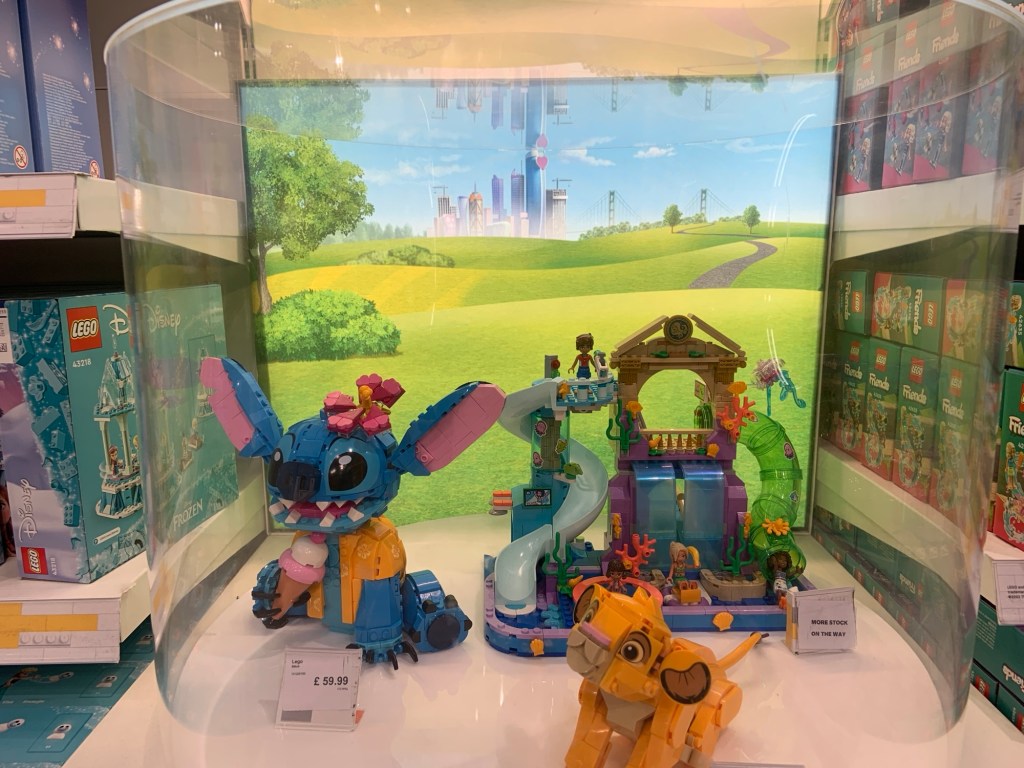
Proceeding on, in one of the glass domes at the back I see Simba, before he becomes King, sat next to Stitch, who holds an ice cream – of course.
Part of the ‘Friends’ series sits to the right of them in this same giant dome. (Picture below). I see a structure with a waterfall at its centre, rushing forward below a stone arch and a balcony, flanked with coral and climbers (more of the organic world). What are the Friends up to?
To either side are water slides: at the end of the transparent green slide to the right, a smiling, bull-eyed Friend whooshes out, arms raised. Everything happens in this static present tense, but can be moved, and rearranged; we are made aware of what has just happened, and what might happen next, like in a Caravaggio.
On the left, another of the Friends, with a kind of self-satisfied smirk on their face, looks straight ahead, and not at the blue slide they are about to go down. When they do eventually ride that slide, they will sense a flash around halfway down – it’s a green camera, photographing them, as happens in many a Theme Park. Below that, facing myself as onlooker at this dome, and above the end part of the slide, is a screen, on which appears the camera’s photograph of the previous slider: arms outstretched, smile and mouth wide, thick black hair, and a stream of water behind them, as a splash made visible on the side of the slide is rendered through two water drops.
So, I’m seeing a reproduction, within this water slide and water fall Grecian colonnade, of a moment before; the creation of a past within this mini-world, of a history, and the means of reproduction of this history (a camera, a screen) – as if the Friends, on what felt like a crazy whim but which probably didn’t dent their bank accounts, installed their own slide camera and screen, like at the theme parks, just for the hell of it.
I’m baffled at the complexity of it, but not surprised at is brazenness. This is the modern world after all.
And then, behind the dome – we haven’t left yet – we see the background to all of this non-place – one translation of ‘utopia’. The ultimate fantasy that, indeed, makes all of this possible: the coexistence of green, flat, yellow-tinged land, sparsely populated with trees and shrubbery, apparently devoid of arable or pastoral use, sits in front of a distant cityscape with skyscrapers and a bridge – think The City, La Défense. In this unnamed, unknown, city, the tallest building bears a giant, huge pink love heart ❤ on its visible side; to the left, a crane is seen, busy expanding and building new developments – of course.
I Heart New York.
Whether this new development will encroach on all the pleasant green land immediately before us, we can only wonder; but, for the most part, finance capital and suburban park land, through which we can stroll down a grey path towards the vanishing point, coexist pleasantly, and sunnily, on this sparsely-clouded day.
I ask myself: who is this for? And what is this all about? Is it for the kids?
‘The face that the world that turns to us’ here, to use Benjamin’s phrase, is the world of capital, of corporation, of fossil fuel fantasy. At least of the critical adult.
And on the whole, even five minutes in the Lego store one is witness to the adultization of these toys, of Lego, by which I mean the usurpation of play towards adulterated, narcissistic ends. By which I mean they have become about a version of ‘us’, our consumer preferences, not about discovery and imagination.
It is, let us begin, certainly not the kind of play that Didi-Hubermann referred to in his essay, which I began this piece with. Was the Lego he addressed of a former, better time – or is that in itself a nostalgic projection? The narcissism of contemporary Lego manifests in the usurpation of its tactile language towards the ends of commodities, capitalist fantasies, only knowable to the adult world, and made only for them – the passing parent. (One child in the store could not decide between the Weasley’s Ford seconded by Ron to rescue Harry in Harry Potter and the Chamber of Secrets, or an orchid, presumably also in the ‘Botanicals Range’ like the Poinsettia; the child described the orchid, in German, as ‘schön’, beautiful).
For example, in most of the sets that partner with, say, the Concorde, Star Wars, or the Land Rover Defender, children do not know these things as adults do – they have not experienced them yet, or, they know them in a much more superficial way, say, without layers of nostalgia, without having been a fan of said film franchise, or without knowing the social significations of such and such a product or brand. Made for adults, by adults, it seems.
Even those child-friendly versions of Lego sets have been, in one aspect, usurped by modern technology: the elf drives a delivery truck at Santa’s post office, the slider gets their picture taken as they whizz down just a short while from the financial centre of the city. It’s like they have redefined life as not compatible without these kinds of technologies, they have presented a usurped version of life. Capitalist realism, as Mark Fisher called it. You might argue these just reflect contemporary life, but I think that that can only be a partial reflection, and one that supports an array of harmful ideas about, say, the benevolence of finance capital, the coexistence of pleasing nature with modern technologies and aviation, or sustains modern myths only developed during the globalization’s progress (e.g. the Poinsettia).
I looked through a Lego set of instructions from start to finish recently, and they carry a reference to changing the world within them; one might imagine, of course, the joy of building, the piecing together, of disparate pieces coming together. Of following instructions to a particular end. Perhaps this is what children want; no doubt I did this when I made and painted model cars as a kid. So I am only noticing, years later, what I myself experienced. And perhaps this is what will relax an adult in their downtime.
But it also and perhaps most worringly, represents to me a narrowing of that imaginative, curious, weird, wonderful, expansive, unknown and unknowing, dispersive mind which does not know of plans building towards pre-given ends. If this is only the definition of play, it is a withered one. Adoration of said film, franchise, or mode of transport aside, the adultization of Lego involves reconstructing the toy towards exactly what Benjamin called the adult’s ‘requisites and instruments’. Building for the self-recognition of the nostalgic adult, of the film fan, of the Formula One fan, should they go for that particular Petronas set, sits somewhat awkwardly with Didi-Hubermann’s articulation of imagination as ‘a perpetual revival of movements that are engaged, contradicted, surprised by new branchings’. So how can Lego feature in this equation?
You might argue that the very act of an adult constructing a Lego Star Wars death star, say, for the purposes of sheer enjoyment, of coming closer to understanding its immense construction, of feeling as though you are bringing this fictional space vessel to life, embraces a kind of naiveté of the child; it lands the adult back into their child-self, of constructing for pure pleasure, not for utility, in an act of commemoration, adoration, admiration, of mindful activity outside of work. This may be true. But for the case of my argument here, the presence of a requisite end is definition enough of the opposite of play in its fullest sense.
We might say that instead of embracing the kind of play and imaginative relating that runs through Benjamin’s children at the scrap heap among the detritus and in Didi-Hubermann’s definitions, the Lego build reinforces nostalgia and relinquishes the adult of any real creative agency. Perhaps this is why companies and franchises love Lego: it allows them a way to extend their sprawl, to give fans the feeling that they have, for once, some kind of creative agency in the making of their favourite cultural product. Participation in furthering these ideologies – after all, they do not begin with Lego. But shouldn’t they end with it?
Without wanting to take away the feelings of pleasure, humble activity, mindfulness, quietness, that such an activity may bring, it is clear that contemporary Lego has embraced a narcissistic, mirror-like version of play, which compounds nostalgic and adulation, and sells adults back to them the idea of play which is not play at all, but, in a funny turn of phrase, actually infantilised play, different from children’s activity. It reinforces finance capital’s merry vision of coexistence with a version of nature-lite, which is really the death of Nature, and sells the conditions of a possible life based on fossil fuelled travel, fast cars, the separation of work and leisure time, the latter being the time in which you build pre-planned Lego sets.
All of which, as the elf sits in their delivery truck, or the water-slide camera photographs the next sliding Lego human presence, functions as a kind of self-reinforcing joke to the adult family members – like the two year-old child in the park on a recent weekend, who sits in an electric powered mini Mercedes on a Sunday afternoon, their responsible adult following around the pond in the park, directing with the remote control. Who’s the joke for, and why?
In the imagery of the Lego store at Gatwick Airport, then, I think we see an example of curtailing children’s imagination to what Mark Fisher called ‘capitalist realism’ – the zone of not only no alternative, but of self-evidence of the modern, of what today is, of lack of doubt in that regard, because everything is fine.
In this way, for adults – after perhaps a momentary joke of seeing the translation of something ‘adult’ into Lego form – the Lego world mimics and mirrors, with no critical attention. It infantilises the prospect of play. Only that reflex of postmodernity, irony, can flex here. And then what?
The radicality of Benjamin’s sketch of children at the scrap heap is that, as I see it, the face that the world turns to them is seen in objects that have no utility at all. They disclose a hidden intimacy that an expansive unstraitjacketed mind can tap into – the secrecy and magic of play. Is this my own fantasy? Perhaps it is. But altogether, it seems that the success of Lego depends on adult-ed requisites and instruments directing the play of children, within a gross cultural ideology that could be accused of brain – or green-washing – the minds of the beholders.
Bibliography
Anton, M. (2008). The bloom is off the poinsettia. [online] Los Angeles Times. Available at: https://www.latimes.com/archives/la-xpm-2008-dec-23-me-poinsettia23-story.html [Accessed 11 May 2025].
Benjamin, W. (2021) ‘One-Way Street’, in One-Way Street. London: Verso.
Didi-Huberman, G. (2024) ‘“Imagination”’, in Raven Row (ed.), S.B. Lillis (tran.) brecht: fragments. London: Raven Row.
NPR (2017). How Poinsettias Became Synonymous With Christmas. [online] NPR. Available at: https://www.npr.org/2017/12/22/573046507/how-poinsettias-became-synonymous-with-christmas [Accessed 11 May 2025].
Wiktionary (2025). lego. In: Wiktionary. [online] Wiktionary. Available at: https://en.wiktionary.org/wiki/lego [Accessed 11 May 2025].
 Laurence Tidy