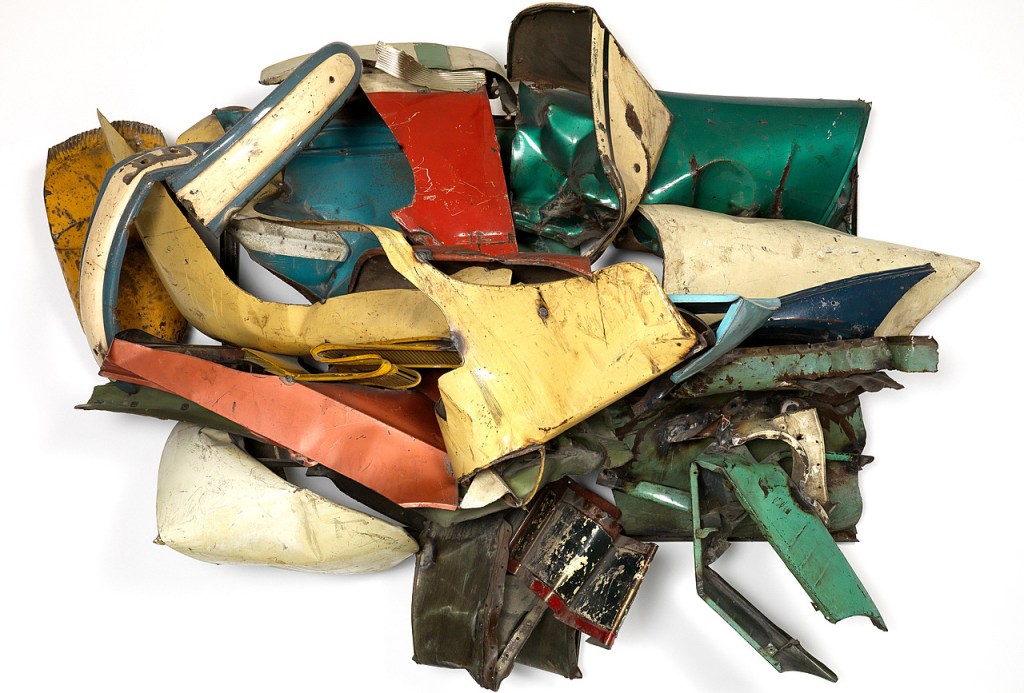
Reviewing the exhibition John Chamberlain: Choices in 2012, David Anfam argues that ‘key to Chamberlain’s technique was an essentially linguistic device, enjambment: evident in the constant pressing together of parts, which he famously celebrated in terms of their ‘fit’, as well as in the compound verbal structures of his fantastical titles’ (Anfam, 2012). Anfam references and illustrates this point with a photograph in the article of The Burlington journal of Chamberlain’s sculpture Dolores James, 1962, painted and chromium-plated steel, 184.2 by 257.8 by 117.5 cm. (Solomon R. Guggenheim Museum, New York). Anfam describes Chamberlain as a ‘collagist’ and states his sculptures ‘collide disparities together’, in a similar vein to Charles Olson’s poetry.
Anfam chooses an inexact poetical device to describe Chamberlain’s sculptures. Enjambment is defined by the Poetry Foundation as ‘The running-over of a sentence or phrase from one poetic line to the next, without terminal punctuation; the opposite of end-stopped’ (Poetry Foundation, 2024). The term is French and originated in 1680. Its French definition by the Centre Nationale de Ressources Textuelles et Lexicales (CNRTL) is: ‘rejet au début du vers suivant d’un ou plusieurs mots indispensables à la compréhension du sens du premier vers’ (CNRTL, 2024). ‘Running-over’ and ‘rejet’ are different metaphors: in the first, the words spill, outlast, cross a threshold, whilst in the second, ‘le rejet’ implies rejection, push back, push away or – along the lines of its botanical sense – shoot off (as in a plant that grows a new shoot).
I don’t think enjambement is the correct term here. Anfam’s description points to two different senses: enjambement on the one hand and, in the sentence that follows, the verb ‘pressing together’, the noun ‘fit’, and the adjective ‘compound’ (referring to the titles of Chamberlain’s works). Enjambement is not to press together: running over implies the action of outrunning the sentence, of meaning – or words, at least – spilling over, running on and down, whilst ‘rejet’ implies a similar but more active ‘rejection’ to the next line – a ‘repoussement’, a pushing off, down. ‘Compound’ refers to combination, as in a chemical element: Chamberlains’s sculptures, certainly, are compounds, and in the case of Dolores James this involves welding steel, joined steel. But enjambement is not to join, it is precisely its opposite.
Let’s look at William Carlos William’s poem ‘Between Walls’, provided as an illustration of enjambement by the Poetry Foundation (Poetry Foundation, 2024).
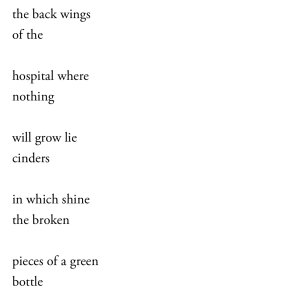
As the website points out, the poem is one sentence, with no capital letter or full stop, broken into ten lines. The metaphor of a poem being broken is aready a clue as to how enjambement proceeds: through fragmentation, separation. Enjambement is a structural strategy: it might involve, one assumes, playing and experimenting with how meaning is affected when the parts of an expression – a sentence – are devolved, moved down, taken away and pushed further on; poetry as an experiment in spatial and temporal composition as well as linguistic. ‘Composition,’ Deleuze and Guattari (2015) wrote, ‘is the definition of a work of art’. Broken line, ‘broken / pieces of a green / bottle’. Suspended and postponed, the delay of the next line creates tension, suspense; there is something pitiful, tragic, about ‘the back wings’, where ‘cinders’ – ash, burnt material – are the only material object to fill a whole line, or for the line to be full of only ash, full of only ‘cinders’. Mirroring the ‘broken / pieces of a green / bottle’, the sentence is chopped, stopped as we proceed we are, poetry having recourse to the reconfiguration of sense through space and deployment of emotion through this postponement of the line, as we read the poem differently – with more difficulty – than we would usually do the “bare line”.
The fragmentation – the rejection, repoussement, of the next word or words, the pushing on – all this reveals that the line, in poetry, if not end-stopped, curtails our speech, stops it short anyway, as a sort of phantom caesura, as we register this flowing onto, and, yet, are required, in order to faithfully respond to what we see, to enunciate this broken sense, this act of enjambement, through our speech. Not all poetry which enjambs, to use the Anglicized version of the French verb enjamber, can be said to reflect a sense of flow. In any case, the analogy to Chamberlain’s sculpture is inaccurate.
Juxtaposition might offer a more fitting description, but the term more readily evokes difference in the elements juxtaposed or collaged. Of course, colours could be juxtaposed, or the directions of the car bumpers in Chamberlain’s sculptures, as could any element of visual language. That we could explore more fully by studying the ways in which Chamberlain structured his welded forms. ‘The logic of sensation’ afforded by the ‘compound of affects and percepts’ in the work of art, as Deleuze and Guattari (2015) articulate, hits our eyes and plays across our nervous system precisely through the adjacent placement of colour, form, and textual exchanges; they sizzle, hit us, appease us through green at one end, agonizing us with red in the centre, and pacifying us with white at another. No doubt there are more exchanges to be noted.
In any case, the compounded, welded, fitted assemblages such as Dolores James inexactly represent Anfam’s extraction from the dictionary of poetic technique, enjambement. Play devil’s advocate for a minute and understand words and phrases, at the mercy of collage, plucked and put together, but strewn along separate lines; we have a poem near to WIlliam Carlos Williams’ Between Walls. Then, take a pool of spoiled, warped, and bent car bumpers and, like limbs of a body, interlock them into some unholy, profane Frankenstein-like beast, orgiastically pointing legs downwards and arms upwards, thrusting bodies out, across, or woven in; notice the exchanges of colour that play across your visual field, a crux and joining of forms, shapes, and lines, into this monstrous industrial unity which seems, paradoxically, to want to be hugged, no doubt through its chromatic gifts. There we have something more like Chamberlain. Is all that is different the linear passing of time in the poem, line by line, down from one to the next, cut up and enjambed as it is, in contrast to the fact that our experience of Dolores James is as a complex, compound unity? The poem as temporal, narrative experience; Dolores James as complete, if assembled, object?
Perhaps my feeling can be summarised like this: enjambement precedes the sentence. Splicing the sentence, disarticulating it through line separation, extends, dramatises and emphasises its parts, some parts specifically more than others; whereas, assembling the parts, finding new articulations, precisely relies on the activity of immanent construction, of binding, layering, and juxtaposing. A further simplification: the poet starts with the sentence. But this may not be true and, furthermore, the act of enjambement, of moving around the phrases and words, creates new meanings. The poet assembles, arranges, too. But the assemblage artist, such as Chamberlain, does not handle one sentence (or more, in the case of other poems). What is its equivalent?
The meaning of the poem is in its composition, the arrangement of its parts, as well as those parts (their resonances, sounds, associations, order…); likewise the assembled sculpture. Perhaps, then, Anfam’s description highlights how both poet and assemblagist are involved in spatial composition, in the arrangement of parts across the patterns of articulated speech through time (Williams) and the ‘logic of sensation’ that plays across the visual field upon optical acquaintance with Dolores James (Chamberlain), even if enjambement is technically inexact.
‘Of course it is inexact; it is a metaphor’. But the dislocations and assembly of Chamberlain’s sculpture lie in layering over, rendering invisible and then visible; call on bends and folds; enact moments of cutting off, stopping, then continuing on; and, all the while, there are whole surfaces we cannot see.
Can the same be said of the words of the poem? Are there words we cannot see?
*
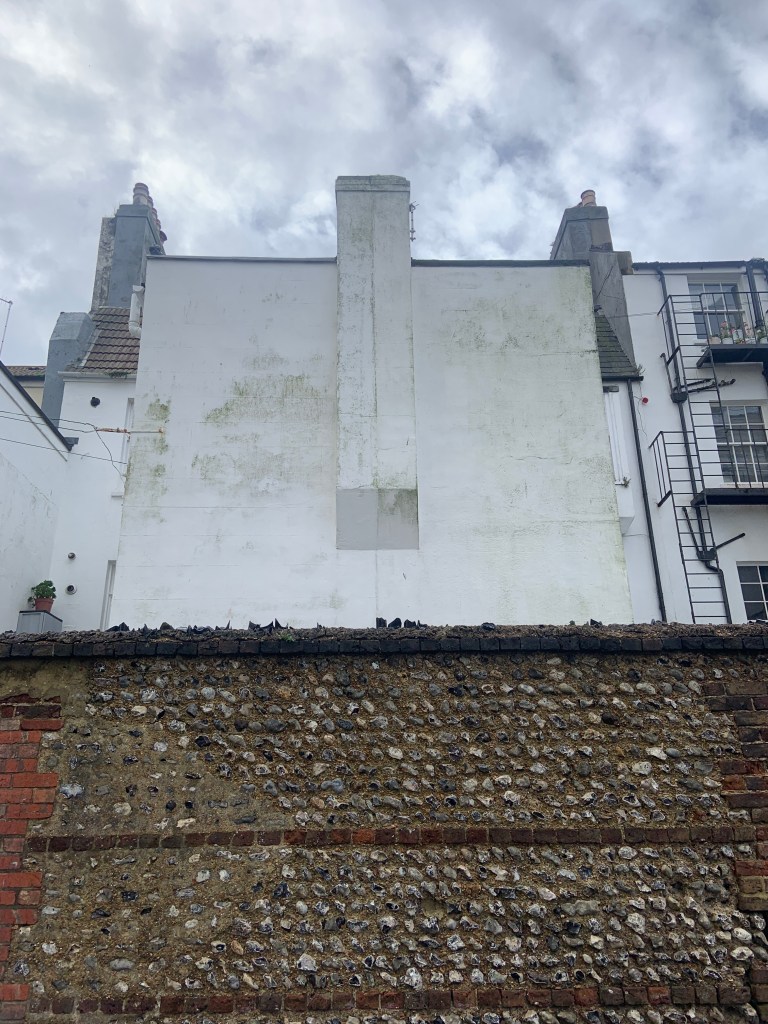
Epilogue in the form of a picture: broken glass bottles on top of a garden wall, Brighton, UK, 2024. Picture the author’s.
Copyright text Laurence Tidy (C)
References
Anfam, D. (2012). John Chamberlain: New York and Bilbao. The Burlington Magazine, [online] 154(1311), pp.448–449. doi:https://www.jstor.org/stable/23233009.
Deleuze, G. and Guattari, F. (2015). What is philosophy? London ; New York: Verso.
Poetry Foundation (2024). Enjambment. [online] The Poetry Foundation. Available at: https://www.poetryfoundation.org/education/glossary/enjambment.
William Carlos Williams (2020). Between Walls by William Carlos Williams | Poetry Foundation. [online] Poetry Foundation. Available at: https://www.poetryfoundation.org/poems/49849/between-walls.
 Laurence Tidy